
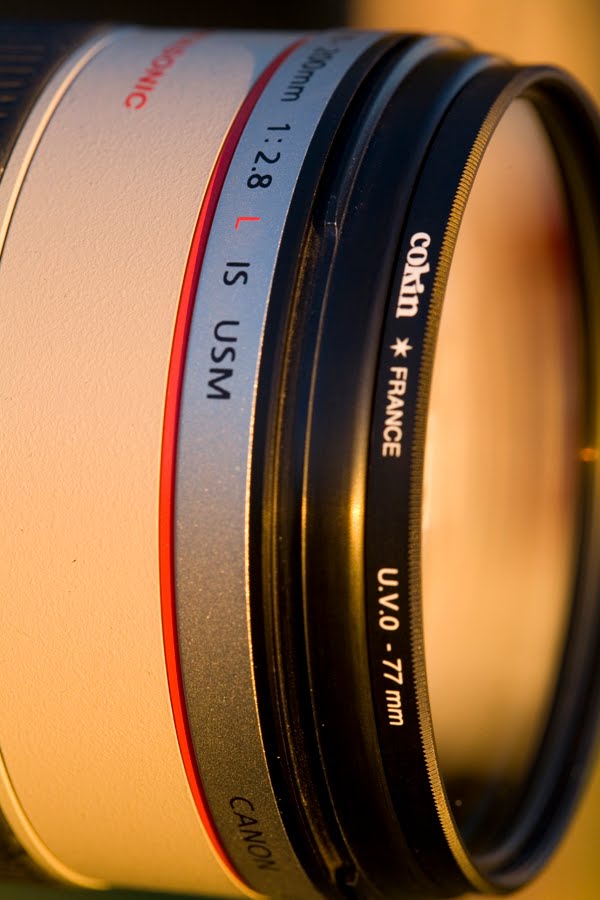
What does it do...what does it NOT do...and what should it do for you?
Let's start with what it is...
UV filters go by a few other names such as lens protection filters, haze filters skylight filters...although a skylight is technically rather an indoor lighting filter...and who knows how many others but they have been with us since the days of film and they will hopefully be around for a long time yet.
A UV filter is essentially a round piece of glass inside a metal bezel with screw thread so it can screw onto the front of the lens. It is optically neutral and should not contain any optical impurity or colour cast. In theory it should improve landscapes by cutting through the blue haze of bright harsh daylight and improve general harsh light conditions because of it's ultra-violet cutting capabilities...here follows some geekspeak...
That which we know as white light is electromagnetic energy which fits somewhere between radio waves and micro waves on the low frequency or long wavelength end and X-rays and Gamma rays on the high frequency or short wavelength end.
It is generally accepted to start at approximately 400 Nanometer at the low frequency side where Infrared becomes visible red light and end at the high frequency end at approximately 700 Nanometer where visible violet light transitions to invisible ultraviolet light.
Let's start with wat it does not do...
It does not cut out UV light completely!
Some top notch UV filters are said to make a bit of a difference from 350 Nanometer to 400 Nanometer but most cheaper ones don't make much of a difference above or below 400 Nanometer.
Anyone wanting to know more about this, place a comment, mail me or something or read the next paragraph for a clue in finding the long and technical answer. I love the technical stuff but I did promise to keep the geekspeak to a minimum, remember?
Now, if you Google it,you are bound to find dozens of sites and more opinions showing and endless variation of graphs and all sorts of "scientific evidence" on many brands of UV filters, some known some not. Not my kind of thing. Interesting when I am extremely bored and the lawn is done and there is no ironing to be done...
So what is the bottom line here then? Let's look at what a UV filter will do for you...It can and will protect the front element of your lens. Optical glass used in camera lenses and other high precision optical instruments is MUCH softer than normal window glass and it is also coated with various secret goodies which improve the passage of light through them.
The price you pay for this protection of your lens, apart from buying the UV filter to begin with, is a slight to very slight to possibly non-existent sacrifice of image quality.
So the bottom line is simple really, let your shooting environment dictate in using a UV filter as lens protection at a nominal or non-existent fee...except for buying it of course. That fee will be degradation of image quality.
The coatings on lenses and the optical glass used in lenses are quite fragile. Now before the $20-filter-on-a-$1000-lens gang comes a calling with violin cases, please hear me out.
If photographing off-road motorsport is your thing, fit one and have two in the bag for back-up. Stones fly about and having your $ 1000.00 lens' front element dinged is bound to spoil your day or maybe even your week. It will also most certainly lighten your wallet considerably regardless of whether the lens is repaired or replaced.
It happened to a mate right next to me...he wrote off a $100 polarizer but saved his $ 2000 lens when a little pebble flew off a rally car's wheel.
Similarly, if surfers or seascapes float your boat, fit a UV filter. All that sea air may not ruin your lens after the third shoot but will do it's bit to give you a hard time cleaning the front element. Heaven forbid some salt spray should splash onto it.
No doubt there are many other situations where a UV filter can save a lens...little ones and sticky fingers...so if you need it, fit it.
But for goodness sakes, PLEASE buy and fit a decent brand. A bum UV filter can make you think your lens is faulty. You might discover this only after your nice annual overseas holiday or safari or honeymoon. No problem...simply go again and redo all those pics. Yeah right...and we all go by the surname of Branson and all those lions will be waiting on the same spot.
This blog is not about flaming brands and so I shall refrain from pushing or flaming any brand of any type of equipment unless there is a really good reason to do so but what I can say is go for a high quality (read: EXPENSIVE) Hoya or similar well-known brand. Please don't buy the one that has been collecting dust in your local camera store for the last 10 years either. Get recent stuff that has been designed for recent lenses in the digital era.
Personally, my 70-200 zoom is my mainstay lens and this has a Cokin slimline UV on it...which comes off as soon as shooting conditions allow it. My lenses used in studio-type environments do not have UV filters and will most likely never get any either.
Why is this you ask? Because a UV filter does degrade image quality. To such a small extent that it might not be worth mentioning but it does degrade image quality all the same.
How much? Well, have a look at the examples down below and you be the judge.
Think about it, shooting all your images through an extra piece of window glass which was never placed there by the designers of the lens...OK, I am sure the good folks at UV filter factory X might be offended but I have seen (and owned, yes...sigh...) some UV filters that could be jolly happy to be compared to window glass.
Fact remains, even if your UV filter is top brand X's best model, it may cause some unnecessary hassles when light bounces between the UV filter and the front element. There are more than enough places inside the lens and camera where light does bounce around and do other unwanted things, why then, would you want to add one more deliberately?
Which brings us to part 2... The matter of hoods.
No comments:
Post a Comment